Tile Calculator
Find how many tiles and boxes you need for a floor or a wall, with the right extra for cuts and breakage.
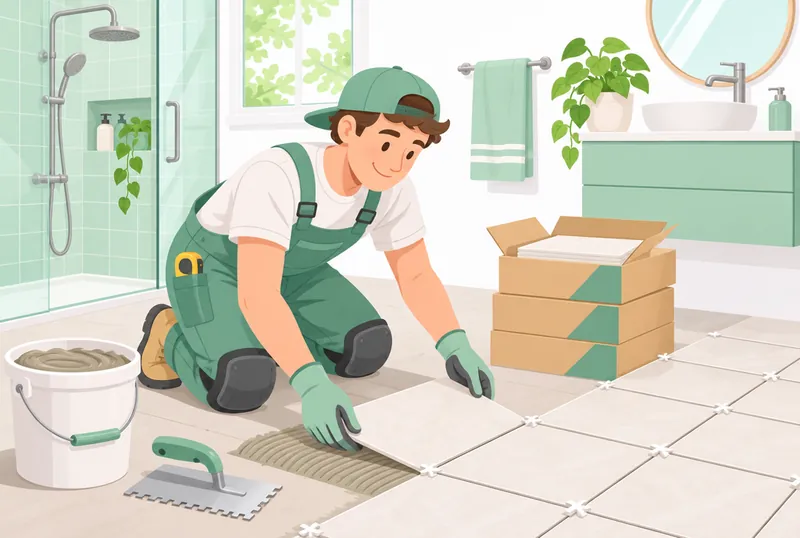
Full tile Cut tile
—
Buy all your tiles at once and check that the boxes show the same batch (lot) number: color and size can vary a little between batches.
How the calculator works
It multiplies the length by the width to get the area, and divides it by the space one tile takes, which is the tile plus one grout joint on each side. Then it adds the extra for your layout and rounds up to whole tiles. If you enter how many tiles come in a box, it also tells you how many boxes to buy.
For an L-shaped room, split it into two rectangles, calculate each one and add them up. For a wall, use the wall width and the height you want to tile, and take away large openings such as a window or a door.
How much waste to add
Every tiling job has cuts at the edges, a few tiles that break, and some that do not match. The usual extra is:
| Layout or situation | Extra to add |
|---|---|
| Straight grid in a simple room | 10% |
| Diagonal (45°) | 15% |
| Herringbone or chevron | 15–20% |
| Many corners, pipes or a small room | add 5% more |
| Large format tiles (24 in / 60 cm and up) | add 5% more |
Keep a few spare tiles after the job. If one cracks in five years, the same model may no longer be sold, and a spare saves you from retiling a whole area.
A worked example
A bathroom floor of 8 x 6 ft with 12 x 12 inch tiles in a straight layout:
- Area: 8 x 6 = 48 sq ft.
- Each tile covers about 1 sq ft, so about 48 tiles once the grout joint is counted.
- Plus 10%: 53 tiles.
- If a box holds 10 tiles, buy 6 boxes (60 tiles) and keep the rest as spares.
Common tile sizes
| Tile size | Area of one tile | Tiles per sq ft / per m² |
|---|---|---|
| 4 x 4 in (10 x 10 cm) | 0.11 sq ft | 9 / 100 |
| 3 x 6 in subway (7.5 x 15 cm) | 0.125 sq ft | 8 / 89 |
| 12 x 12 in (30 x 30 cm) | 1 sq ft | 1 / 11 |
| 12 x 24 in (30 x 60 cm) | 2 sq ft | 0.5 / 5.6 |
| 24 x 24 in (60 x 60 cm) | 4 sq ft | 0.25 / 2.8 |
Values without grout joints, rounded. Real tiles are often a few millimeters smaller than their name.
Before you buy
- Check the floor. Tiles need a flat, stable base. Big dips or a floor that flexes will crack tiles and grout.
- Pick the joint width first. Rectified tiles allow thin joints of 1/16 to 1/8 inch (1.5 to 3 mm); handmade or rustic tiles need wider joints.
- Order adhesive and grout too. The bag usually says how much area it covers for a given tile size.
- Lay out a dry row. Placing a row of tiles without adhesive shows where the cuts will fall, so you can avoid thin slivers at a doorway.
Frequently asked questions
How much extra tile should I buy?
About 10% for a straight layout, 15% for diagonal and 15 to 20% for herringbone or rooms with many corners. Large tiles and natural stone also need more.
How many 12x12 tiles do I need for 100 square feet?
A 12 x 12 inch tile covers 1 sq ft, so 100 sq ft needs 100 tiles. With 10% waste for a straight layout, buy 110.
Does the grout line change how many tiles I need?
Slightly. A grout joint makes each tile take a little more space, so you need a few less tiles. For small tiles with wide joints the effect is bigger.
Can I return extra boxes?
Many stores accept unopened boxes back, but not all, and special orders usually cannot be returned. Ask before you buy.
Painting the walls too? Use the paint calculator.
 Paint calculator
 Flooring calculator
 Concrete calculator
 Wallpaper calculator